For more than six decades, New York City’s zoning code has shaped the way the city grows ,builds, and evolves. First enacted in 1961, it has long been considered one of the most complex and restrictive zoning frameworks in the country, which has struggled to keep up with modern demands.
That’s now changing.
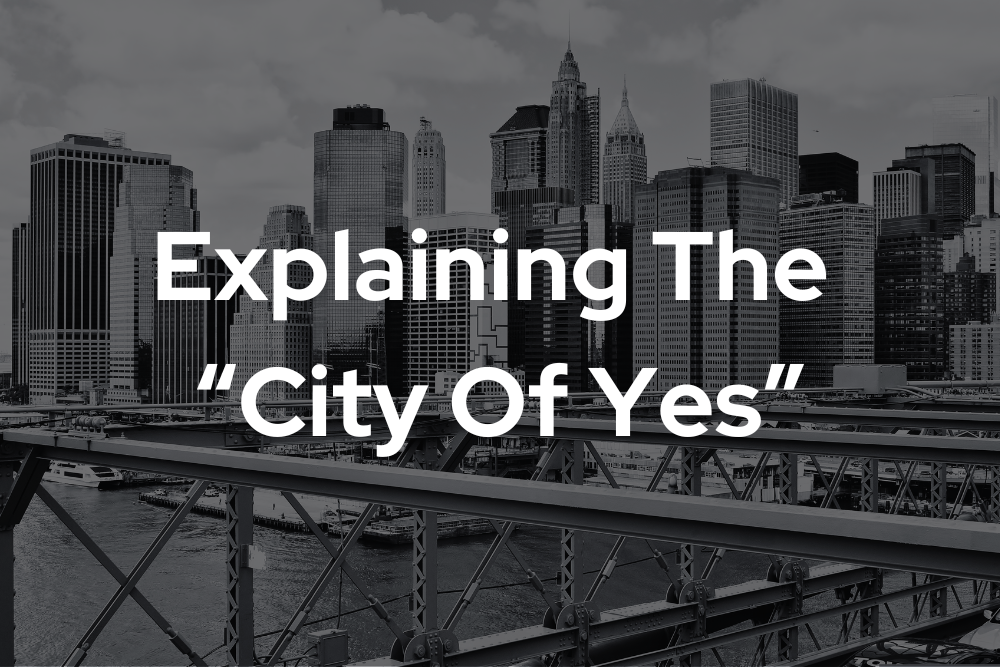
Under the leadership of former Mayor Eric Adams, New York City has launched one of the most ambitious zoning reform efforts in its history: the City of Yes initiative. This three-phase overhaul represents how the city has changed its approach on sustainability, economic development, and most critically, housing.
Rather than a single sweeping reform, City of Yes is a strategic dismantling of outdated barriers, designed to unlock growth across all five boroughs.
A Once-in-a-Generation Zoning Transformation
The scale of this initiative is hard to overstate. After 63 years without a comprehensive overhaul, the City of Yes introduces a coordinated set of reforms projected to enable 80,000 new homes over the next 15 years, while modernizing how businesses operate and accelerating the city’s transition toward a cleaner, more sustainable future.
The initiative is structured into three phases, each targeting a different pillar of urban development:
- Phase 1: Carbon Neutrality (December 2023)
- Phase 2: Economic Opportunity (June 2024)
- Phase 3: Housing Opportunity (December 2024)
Together, they redefine what is possible under NYC zoning.
Phase 1: Clearing the Path for a Greener City
The first phase tackled a surprising obstacle to sustainability, zoning itself.
For years, outdated regulations have limited the adoption of clean energy technologies. Phase One removes many of these barriers, making it significantly easier for building owners and developers to invest in sustainable upgrades.
Key changes include:
- Removing restrictions on solar panel installations and rooftop energy systems
- Expanding access to EV charging infrastructure in garages and parking facilities
- Broadening eligibility for green roofs
- Streamlining approvals for energy retrofits and heat pumps
The result is a zoning framework that no longer works against climate goals but actively supports them.
Phase 2: Modernizing the Way Business Works
The second phase focuses on economic flexibility, bringing zoning into alignment with how people actually live and work today.
One of the most impactful changes is the overhaul of NYC’s Use Group System, which had remained largely untouched since 1961. The consolidation from 18 groups into 10 simplifies compliance and makes it easier for businesses to adapt and grow.
Other notable updates include:
- Expanding allowable home office space from 25% to 49% of a residence
- Aligning life sciences and office uses, supporting a rapidly growing sector
- Opening more pathways for clean manufacturing within the city
- Introducing new streetscape standards to enhance commercial corridors
This phase shows that zoning is no longer just about restriction, it’s about enabling opportunity.
Phase 3: Addressing NYC’s Housing Crisis Head-On
The third and most consequential phase directly confronts one of the city’s most urgent challenges: housing.
With an estimated 473,000-unit shortfall by 2032, NYC requires bold, systemic solutions. Phase three delivers exactly that, introducing policies designed to unlock new housing supply across a wide range of neighborhoods and building types.
Key Initiatives Include:
Office-to-Residential Conversions
Buildings constructed as recently as 1990 can now be converted into housing, opening up vast portions of underutilized office stock, particularly in Midtown and Lower Manhattan.
Universal Affordability Preference (UAP)
Developers can build up to 20% more housing in certain districts if those additional units are permanently affordable, aligning growth with equity.
Transit-Oriented Development (TOD)
New allowances enable mid-density residential buildings near transit hubs, promoting smarter, more connected growth patterns.
Accessory Dwelling Units (ADUs)
Homeowners can now add backyard cottages, basement apartments, or garage conversions, which will incrementally increasing housing supply in lower-density neighborhoods.
Parking Reform
Parking mandates have been reduced or eliminated in many areas, removing a major cost and space constraint for new development.
New High-Density Districts (R11 & R12)
These districts allow significantly higher density, tied to mandatory affordable housing requirements.
Mixed-Use Expansion (“Town Centers”)
Housing is now permitted above storefronts on more commercial corridors, encouraging vibrant, walkable neighborhoods.
What This Means for the Future of NYC
For decades, NYC zoning accumulated layers of restrictions that often slowed development, limited flexibility, and constrained growth. This initiative reverses that trend, creating a framework that is more adaptive, more transparent, and more aligned with the realities of modern urban life.
For industry professionals, this marks a new era of opportunity, but also complexity. Understanding how these changes interact, where they apply, and how to leverage them will be critical to staying competitive.
For New Yorkers, the impact will be felt more broadly:
- More housing options
- More dynamic neighborhoods
- More sustainable buildings
- A city better positioned for long-term growth
The Bottom Line
City of Yes is a coordinated transformation of how New York City builds, works, and lives.
And while its full impact will unfold over the coming years, one thing is already clear, the rules of development in NYC have fundamentally changed.