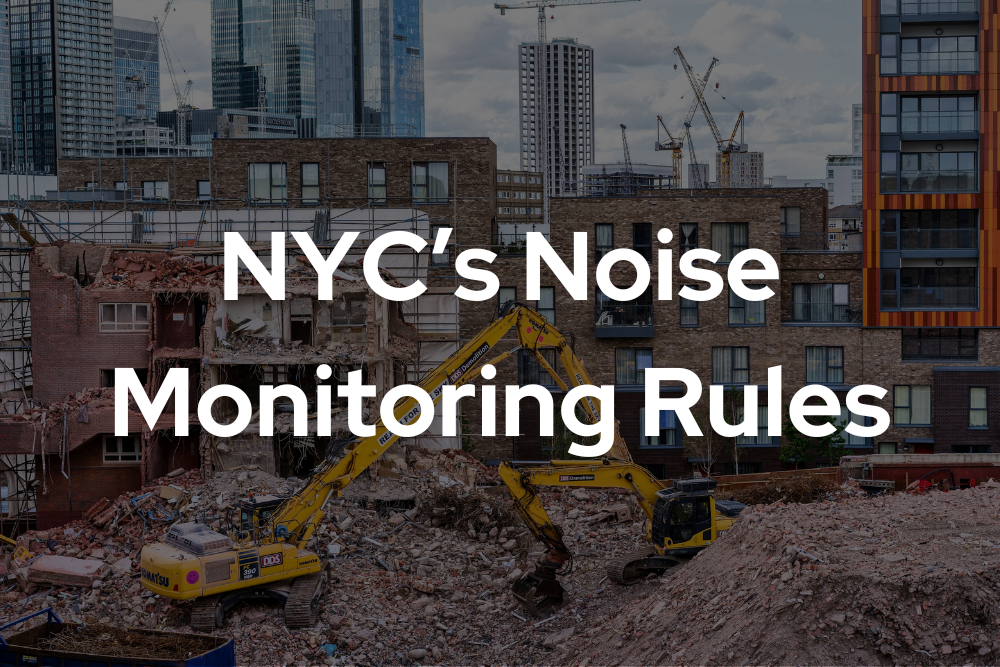
Starting April 21, 2026, New York City is introducing new noise monitoring requirements for projects that can impact timelines, compliance strategies, and project execution for contractors who aren’t prepared. Throughout this article, you’ll learn what’s changing and how to adapt so you can operate with greater transparency, accountability, and control in an increasingly data-driven construction environment.
Why This Rule Exists
Construction noise has long been one of the most common sources of complaints in NYC.
Instead of relying primarily on planned mitigation strategies, the city is requiring continuous, real-world monitoring, creating a system where:
- Noise impacts are measured, not assumed
- Issues can be identified in real time
- Accountability is documented throughout the project life cycle
This change aligns with a major trend across construction and compliance:
- Moving from static documentation to dynamic tracking
Who This Affects
These rules apply to all new building (NB) projects that meet at all of the following:
- ANMPs filed for 30+ days (consecutive or nonconsecutive)
- New buildings with a gross floor area of 200,000+ square feet
- Worksites within 50 feet of residential or sensitive receptors
These thresholds effectively target large-scale, high-impact developments where noise exposure risks are highest. However, if your project already has an ANMP in place, you are not subject to these new rules unless you renew it after the effective date of 4/21/2026.
What’s Actually Changing
1. Noise Monitoring Becomes Continuous
Projects must now deploy at least one noise monitoring device:
- Positioned toward the nearest residential or sensitive receptor
- Collecting data throughout active construction
- Remaining in place until only minimal-noise or interior work remains
This transforms monitoring from a checkpoint activity into a constant project input.
2. Devices Must Meet Defined Technical Standards
The city is also standardizing how noise is measured, not just that it is measured:
- Mounted 8-10 feet above ground
- Installed on a wall or pole
- Wall-mounted units must be more than 1 foot from surfaces to prevent sound distortion
- Must include outdoor microphones with wind/rain protection
- Required to meet Class 2, IEC 61672-1 compliance standards
NYC DEP has published a list of approved devices to help remove any confusion around acceptable equipment.
3. ANMP Applications Become More Detailed
Applications are no longer just about describing the mitigation; they now need to map and define the monitoring strategy:
- Identification of residential and sensitive receptors within 75 feet.
- Use of tools like ZOLA NYC’s Zoning Land & Use Map
- Clear visualization of monitor locations
- Documentation of device counts, placement, and responsible parties
This introduces a new layer of planning coordination between compliance teams, engineers, and field operations.
Exemptions
Not all projects are subject to these requirements:
- Developments where 100% of units are affordable housing (per NYC Administrative Code §24-223(e)(1))
- Emergency construction work
These exemptionsreflect the city’s effort to balance regulatory oversight with practical andsocial priorities.
Why It Matters
Noise complaintsare a major source of friction between construction teams and communities. Byproactively following the new rules, your team can:
- Reduce noise complaints
- Avoid fines and delays
- Demonstrate commitment to community relations
Bottom Line
If your project involvesan ANMP and meets the size or proximity thresholds, now is the time to:
1. Review your noise monitoring strategy
2. Selectcompliant devices
3. Updateyour application workflows and documentation
4. Align your team around real-time tracking and accountability
Because underthese new rules, noise monitoring is now part of how your project will beevaluated, managed, and experienced by the community around it.
Is your teamready to comply with NYC's new construction noise monitoring rules?