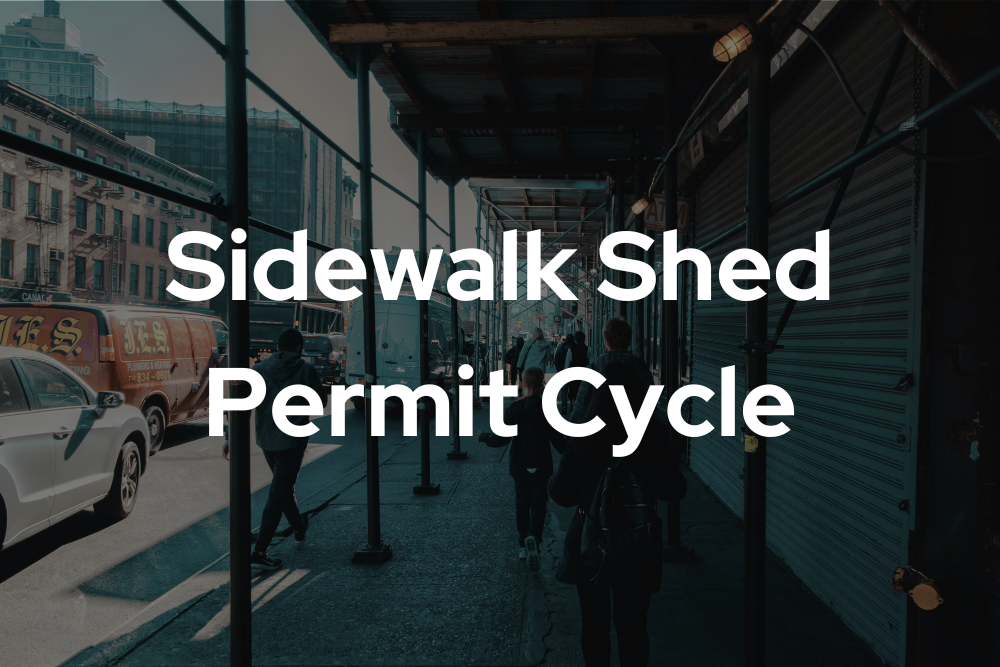
For decades, sidewalk sheds in New York City have been treated as static infrastructure; once installed, they remained in place with minimal ongoing attention.
As we are nearing the end of the 1st 90-day cycle for Sidewalk Shed Permits. Be reminded that sidewalk shed permits issued after January 26thwill no longer auto-renew.
This NYC DOB requirement is transforming sidewalk sheds from a background task into a recurring compliance obligation that demands consistent oversight throughout the life of a project.
From Static Structure to Moving Target
Sidewalk sheds now function on a 90-day cycle. Every cycle will require action and introduce new risks.
Here’s what it looks like in practice:
- Permits expire every 90 days
- Renewals must be filed manually
- Each renewal carries a fee ($130)
- Miss a deadline, the permit can lapse
What used to feel like a long-term installation now behaves more like a short-term permit on repeat.
This shift has changed how teams operate.
More Checkpoints, More Coordination
The new requirements also introduce additional validation steps for certain building types.
Each renewal now requires confirming that the shed is directly tied to active construction work that has the proper permits in place.
That means every renewal isn’t just a formality. It’s a coordination between filings, project status, and active scopes of work.
Without tight alignment, that’s where breakdowns can happen.
NEW: A Progress Report Now Comes With Every Renewal
The DOB just added another layer to the renewal itself. Beginning August 17th, 2026, a Registered Design Professional (RDP) must confirm the status of the work the shed is protecting every time the permit is renewed.
- An RDP must sign off on renewal, reporting progress on the underlying work
- A new $90 progress report fee applies on top of the existing $130 renewal fee, totaling $220 per cycle.
- Sheds tied to one- or two-family homes, or installed under an active new building, enlargement, or demolition permit are exempt from both requirements above.
That's one more moving part, and one more way a renewal can stall if the sign-off and the fee aren't lined up in time.
The Real Risk Isn’t the Rule, It’s the Process
On paper, a 90-day renewal cycle doesn’t sound overly complex.
However, when you’re managing them across multiple properties or active projects, it adds up quickly:
- Dozens of new deadlines to track
- Repetitive filings that can’t be missed
- Increased exposure to violations or stop-work conditions
A missed sidewalk shed renewal can stall progress, delay signoffs, and create unnecessary friction at the worst possible time, when a project is nearing completion.
Why This Shows a Bigger Shift
This change is apart of a broader trend in the industry; compliance in New York City is becoming more continuous and less forgiving.
It’s no longer about hitting a few key milestones; it’s about maintaining alignment across dozens of smaller recurring requirements.
That can become difficult to manage through fragmented systems, email chains, or manual tracking.
Turn Compliance into a System, not a Scramble
To keep pace, teams need to treat compliance as an integrated part of project execution.
That means:
- Knowing exactly when every permit is expiring
- Having clear ownership over renewals
- Maintaining visibility across all active filings
- Ensuring documentation and dependencies are aligned in real time
This is where platforms like SnapCor come into play, by providing teams with a centralized way to track permits, manage deadlines, and maintain visibility across the entire compliance lifecycle.
Instead of chasing renewals, teams can stay ahead of them.